Betty’s Chokecherry Wine
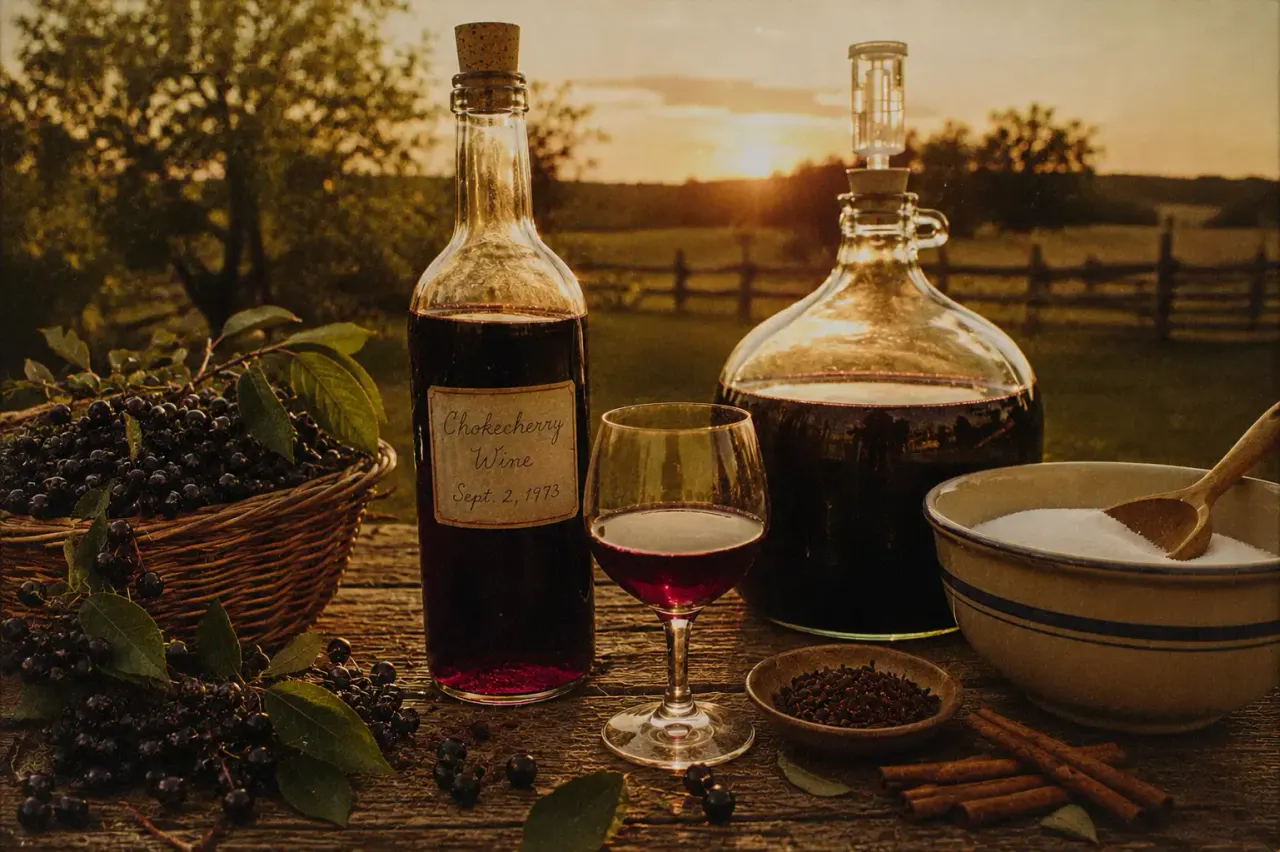
Fully dark chokecherries make a wine with deep berry color and a distinctly tart edge. Months of quiet aging round it into a dry, gently astringent sip.
Recipe link
Prep time1 hr 30 min
Cook time50 min
Total timeABOUT 4 TO 12 MONTHS
- Course
- Beverages
- Cuisine
- Granny's Recipes, American
- Difficulty
- Hard
- Est. calories / serving
- 120
Ingredients
- 4–5 pounds fully ripe chokecherries, approximately 1 gallon by volume, stems, leaves, damaged fruit, and debris removed — approximately 1 gallon by volume, stems, leaves, damaged fruit, and debris removed
- As needed cold water, enough to bring the prepared must to approximately 1 gallon — enough to bring the prepared must to approximately 1 gallon
- 2 ¼ pounds granulated sugar — plus or minus as needed to reach a specific gravity of 1.085 to 1.090
- 1 tablet Campden tablet, crushed — crushed
- ½ teaspoon pectic enzyme
- 1 teaspoon yeast nutrient
- 1 packet wine yeast suitable for fruit wine — such as EC-1118 or K1-V1116
Instructions
- Clean and Sanitize the Equipment: Wash and rinse the primary fermenter, steam juicer, measuring tools, spoon, hydrometer and test jar, thermometer, carboy, bung, airlock, siphon, and every other item that will touch the juice or wine. Sanitize each item according to the sanitizer manufacturer’s required concentration and contact time, then allow it to drain without wiping. No direct heat is required for this step.
- Prepare the Fruit: Rinse the chokecherries under cool running water. Remove the stems, leaves, debris, moldy fruit, badly damaged berries, and any fruit that smells fermented or spoiled. Do not use a blender, food processor, potato masher, or other tool that could break the pits.4 to 5 pounds fully ripe chokecherries
- Extract the Juice: Fill the lower reservoir of a steam juicer according to the manufacturer’s directions. Place the whole chokecherries in the fruit basket. Bring the reservoir water to a boil over high heat, then maintain steady steam. Begin collecting the juice after about 30 minutes and continue steaming for another 15 minutes if the fruit is still releasing juice. Work in batches as needed and stop when the juice flow has slowed substantially. Do not mash the fruit or disturb the pits. Cool the collected juice to 68–75°F before continuing.prepared chokecherries
- Prepare the Sugar Syrup: Place 2 pounds of the granulated sugar and 2 cups cold water in a saucepan. Heat over medium-low heat for 3–5 minutes, stirring until the sugar has completely dissolved and the syrup is clear. Do not caramelize the sugar. Remove from the heat and cool the syrup to 75°F or below.2 pounds granulated sugar, 2 cups cold water
- Build the Must: Pour the cooled chokecherry juice and cooled sugar syrup into the sanitized primary fermenter. Add enough cold water to bring the total volume to approximately 1 gallon and stir for 1 minute. Bring a sample to the hydrometer’s calibration temperature and measure the specific gravity. If the reading is below 1.085, dissolve portions of the remaining sugar in a small amount of must and add them gradually, checking after each addition. Stop when the must reaches 1.085–1.090. Do not exceed 1.090.chokecherry juice, sugar syrup, remaining granulated sugar as needed, cold water
- Condition the Must: Stir the crushed Campden tablet, pectic enzyme, and yeast nutrient into the must for about 30 seconds. Cover the fermenter with its sanitized lid and airlock, or with a clean tightly woven cloth secured against fruit flies. Let the must stand for 24 hours at 65–75°F. Do not add the yeast during this waiting period.1 Campden tablet, ½ teaspoon pectic enzyme, 1 teaspoon yeast nutrient
- Add the Wine Yeast: Prepare the wine yeast according to the package directions and add it to the conditioned must. Stir gently with a sanitized spoon for about 15 seconds. Re-cover the fermenter and keep it at a steady 68–75°F. Visible bubbling or foam should develop as fermentation becomes active.1 packet wine yeast
- Complete the Primary Fermentation: Beginning on the third day, take a sanitized hydrometer reading once daily. Keep the fermenter covered between checks. Primary fermentation is ready for transfer when the specific gravity reaches 1.020–1.030, usually after approximately 3–7 days. Use the hydrometer reading, not the calendar alone, as the deciding cue.
- Rack into the Secondary Fermenter: Place a sanitized carboy below the primary fermenter and use a sanitized siphon to transfer the wine without splashing. Leave the settled sediment behind. During the remaining active fermentation, fill the carboy no higher than its shoulders and attach a sanitized bung and airlock. Keep the wine in a dark place at approximately 60–70°F.
- Finish the Fermentation: Check the specific gravity approximately once each week. Once vigorous fermentation has ended, reduce the headspace to about 1–2 inches below the bung by transferring to a smaller sanitized vessel or topping up with a small amount of compatible finished wine. Fermentation is complete when the specific gravity is below 1.000 and remains unchanged on two readings taken at least 3 days apart.
- Rack and Clear the Wine: Siphon the finished wine into a clean, sanitized carboy while leaving the sediment behind. Replace the airlock and allow the wine to clear in a cool, dark place for 4–8 weeks. Rack again whenever a new visible layer of sediment develops. Continue until the wine is clear and has formed no meaningful new sediment for at least 30 days.
- Bottle the Wine: Sanitize the bottles, siphon, bottling wand, corker, and new corks according to their manufacturers’ directions. Bottle only when the wine is dry, stable, clear, and free of new sediment. Siphon gently into the bottles without splashing and seal with new wine corks.
- Age the Wine: Keep the newly corked bottles upright for 3–5 days so the corks can expand. Store the bottles on their sides in a cool, dark place for at least 2 months before opening. Six to twelve months of aging should produce a rounder, more integrated flavor.
Notes
- Chokecherries: Use only fully ripe, deeply colored berries. Weigh the cleaned fruit during the first test so the final formula can be standardized without losing Betty’s original gallon measure.
- Pit Safety: Never crush, grind, blend, or break the chokecherry pits. Discard all pits and fruit solids after juice extraction.
- Stovetop Extraction: If a steam juicer is unavailable, combine every 4 cups cleaned chokecherries with 1 cup cold water in a stainless-steel or enamel saucepan. Simmer gently over low heat until the fruit is very tender, stirring without mashing the pits. Drain through a damp jelly bag or several layers of cheesecloth without twisting, squeezing, or pressing. Count the extraction water as part of the total water used to prepare the must.
- Sweetness: The base recipe is written as a dry wine. To make a sweeter wine, first stabilize the completely fermented and clear wine with potassium sorbate and the appropriate sulfite treatment according to the products’ directions. Add cooled sugar syrup gradually, then keep the wine under airlock long enough to confirm that fermentation has not restarted before bottling.
- Acid and Tannin: Do not add acid blend or powdered tannin to the first test batch. Record the must’s pH and evaluate the finished wine’s tartness and astringency before deciding whether either addition is necessary.
- Storage: Store corked bottles on their sides in a cool, dark place. Discard wine showing mold, unexpected surface growth, a severe vinegar odor, leaking closures, pushing corks, or unexplained pressure.
- Serving Suggestions: Serve in 5-ounce pours with Cherry Rhubarb Crunch or Old Fashioned Chocolate Cake.
- Alcohol: Intended only for adults of legal drinking age. Do not serve during pregnancy or when alcohol conflicts with medications or health guidance.
- Optional Additions
- cinnamon (sticks)
- orange (peels)
Nutrition (Approximate Per Serving)
Yield
About 4 standard wine bottles — Serving size: About 5 oz
Some ingredients could not be modeled and may meaningfully change the totals. Treat these values as a rough estimate.
- Calories
- 120
- Carbohydrates
- 4 g
- Protein
- 0.1 g
- Fat
- 0 g
- Saturated Fat
- 0 g
- Cholesterol
- 0 mg
- Sodium
- 10 mg
- Fiber
- 0 g
- Total Sugars
- 1.5 g
Equipment
- Winemaking sanitizer
- Steam juicer
- Large nonreactive saucepan (Use for the sugar syrup and the approved stovetop extraction alternative.)
- Food-safe primary fermenter (At least a 2-gallon capacity.)
- Sanitized lid (A clean tightly woven fermentation cloth is the approved alternative.)
- Long-handled spoon
- Measuring cups
- Measuring spoons
- Kitchen scale
- Thermometer
- Hydrometer
- Hydrometer test jar
- Wine thief (A sanitized sampling tool is the approved alternative.)
- Glass or food-safe plastic carboys (Use appropriately sized vessels; smaller carboys may be needed to minimize headspace.)
- Bungs (Match each bung to its carboy.)
- Airlocks
- Auto-siphon (A racking cane is the approved alternative.)
- Food-safe tubing
- Bottling wand
- Wine bottles (Enough for approximately 4 standard wine bottles.)
- New wine corks
- Corker
- Labels (Use to record the batch date and bottling date.)